Garage Door Spring Repair in Yucca Valley, CA
Spring repair in the Yucca Valley area means installing a spring matched to your door's weight and rebalancing it, so neither the opener nor your back has to do the lifting.
A sudden bang in the garage, then a door that won't open or stalls after a few inches: a spring has almost surely failed. Leave it shut, and keep reading before you handle anything.
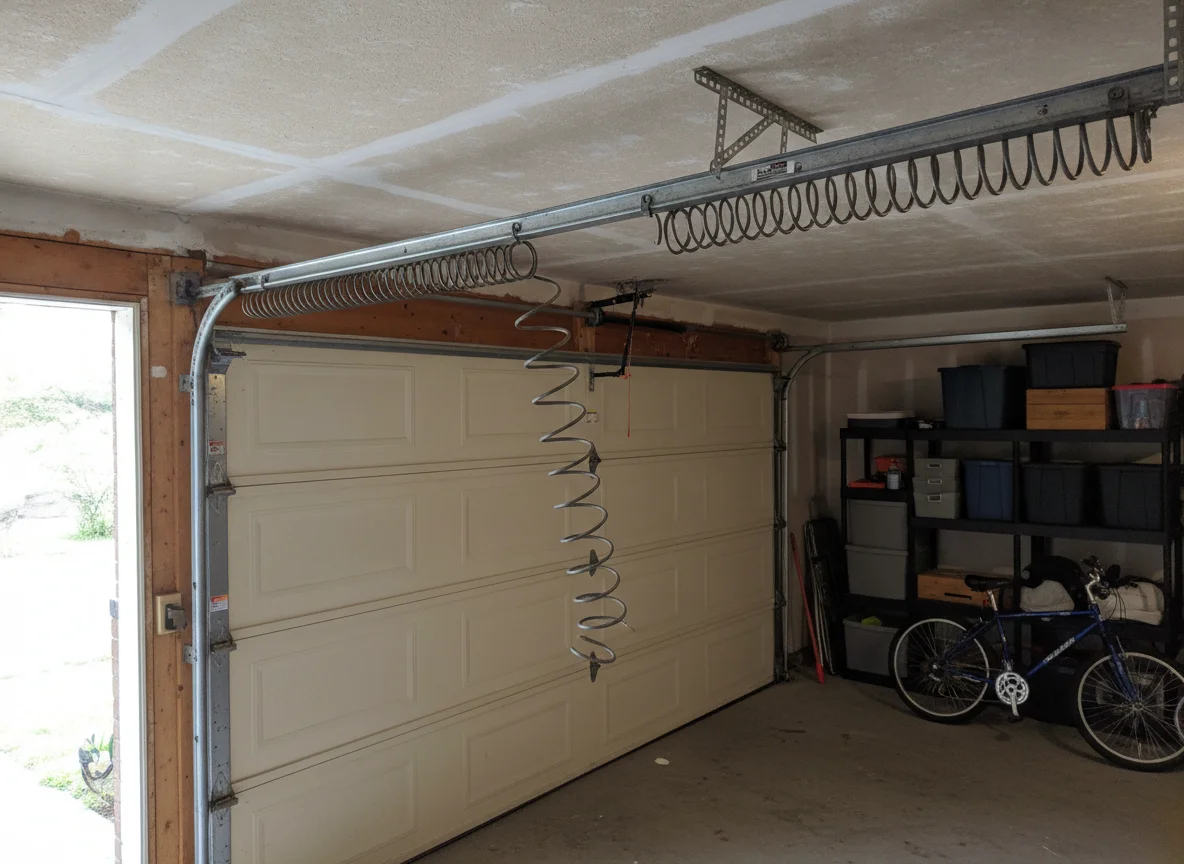
How a broken spring shows
A crack like a gunshot in the garage, frequently while the door sat unused with nobody around. A torsion spring is wound tightest with the door shut, which is the moment many of them finally snap.
A break in the coil
Check the bar over the shut door. A snapped torsion spring leaves a visible split, often a few inches across.
The door feels like dead weight, and drops again if you raise it by hand.
Motor strains, hums, or lifts the door only a few inches before quitting
Many openers feel the extra load and stop, so the opener gets blamed for a spring's fault.
The door rises unevenly, with one side leading. Where a spring runs alongside each track, one of the pair has gone slack.
It slams down through the final foot rather than settling gently.
Loud bang, then a door that won't rise? Keep it shut and describe the bar and springs above it.
Contact UsPrecautions until repair
A wound spring holds enough force to break bones, and with a spring gone the door's whole weight hangs on its hardware. Until someone repairs it:
Skip hand-lifting, and stop pushing the opener button over and over
An opener can't carry that load, and every extra attempt risks stripping its gears.
Never yank the release cord with the door raised
Nothing counterbalances it, so the door can crash down at full weight.
Keep your hands off torsion spring winding or adjusting
Stored force sits at the winding cones, which is exactly where the worst injuries in this work occur.
Keep kids and pets well clear of the door, and avoid parking beneath it when it's stuck half open.
Car stuck in the garage? Let us know when you make contact.
Torsion versus extension springs
Torsion springs mount on a shaft over the door, store energy by twisting, and turn the drums that wind the cables.
Doors from recent decades mostly have them. They raise a door more smoothly and fail more safely than extension springs, since a broken one stays on its shaft.
Extension springs lie beside the horizontal rails and stretch as the door comes down. Older, lighter doors tend to use them. Each needs a safety cable through its core, or a broken spring can lash across the garage and hit anything in its path.
If your door lacks that cable, adding one is worthwhile, broken spring or not.
Most older extension-spring doors can be converted to torsion springs, a fair question to raise; the Contractors State License Board lists such door work under its D-28 class.
How a spring job unfolds
The failed spring gets measured and matched
The measurements: wire thickness, coil diameter, length and wind direction. Get one wrong and the door will not balance.
Your door's weight sets the spring
The right spring is picked for your door's load, not for being whatever is closest to hand.
The failed spring is removed carefully, any leftover tension is relieved before bolts come loose.
The replacement is mounted and wound or hooked up, and cables are verified on the drums so both sides rise together.
Balance gets checked by hand
Disengage the opener: a balanced door stays put at waist height. Fault lines cross the Morongo Basin, so repeat this test after any strong shake.
Say what the door is doing
A couple of lines will do to begin with. There's no need to know what the failed part is called.
Replace one or both?
With a pair of springs, each has done identical work on the same door. Once one snaps, the other often follows not long after.
Changing the pair together avoids a repeat visit and keeps the door in balance, since a fresh spring beside an old one pulls unevenly.
Ask the provider what they advise for your door, and why. If yours has just one spring, ask whether two would lift it better and last longer.
What shapes a spring repair bill
Torsion or extension type, plus whether it has one spring or two.
Door size and mass
Springs for a two-car door, solid wood or insulated steel are heavier duty than those for a light single door.
Rated cycle count
Each spring carries a rating for how many open-and-close cycles it should survive. A higher rating costs more but suits a door that moves many times daily.
Other tired parts
Frayed cables at the drums, dragging rollers, or tired bearings on the torsion shaft are easier to change while the door is already being worked on.
Switching from extension to torsion springs, should you want that.
How long do springs last?
Use matters much more than age. The same cycle-rated spring will serve years longer on a door opened a few times a day than on one that is the family's everyday entrance and sees constant traffic.
Snow falls nearly every year in this cold desert climate, and chilly mornings are when many worn springs finally give out.
Springs that failed early may call for a higher-cycle replacement; raise it.
The extra cost is typically modest compared with a repeat repair.
If the spring is fine
Nothing snapped, yet the door is loud or sluggish
A maintenance visit inspects the springs ahead of any break.
Quick answers
Is changing a spring a homeowner job?
Extension springs can be a homeowner project when safety cables are in place and the door is fully raised and clamped.
Torsion springs are not. Winding takes proper winding bars plus the exact spring specs, and one slip sends the full stored force through your hands. Of all garage door repairs, this is where hiring someone is as much about safety as convenience.
Can I raise the door to free my car?
Not safely once a spring is broken. Keep it shut and mention the car when you reach out.
Why did a spring snap while nobody touched the door?
Every cycle fatigues a spring a little, and a torsion spring carries the most tension when the door is shut. The final failure often happens right then, and cold can make spring steel brittle. It doesn't mean anything else is wrong.
Is a new opener needed with a new spring?
Seldom. If the opener fought a broken spring for a while, though, have its gears checked for stripping or wear.
More garage door help
Garage Door Cable Repair
Lift cables that frayed, broke or slipped off, and doors that sag.
Read more →Garage Door Opener Repair
Openers that hum, bounce back or stay silent, plus replacements when fixing no longer pays.
Read more →Garage Door Maintenance
A preventive checkup of springs, cables, rollers and safety reversal before anything breaks.
Read more →Reach out
Say whether it's a one-car or two-car door, what you heard, whether the door moves at all, and if a vehicle is trapped inside.
A photo of the spring over the shut door, taken from the floor, shows the spring type and where it broke.